Catholic Hospital
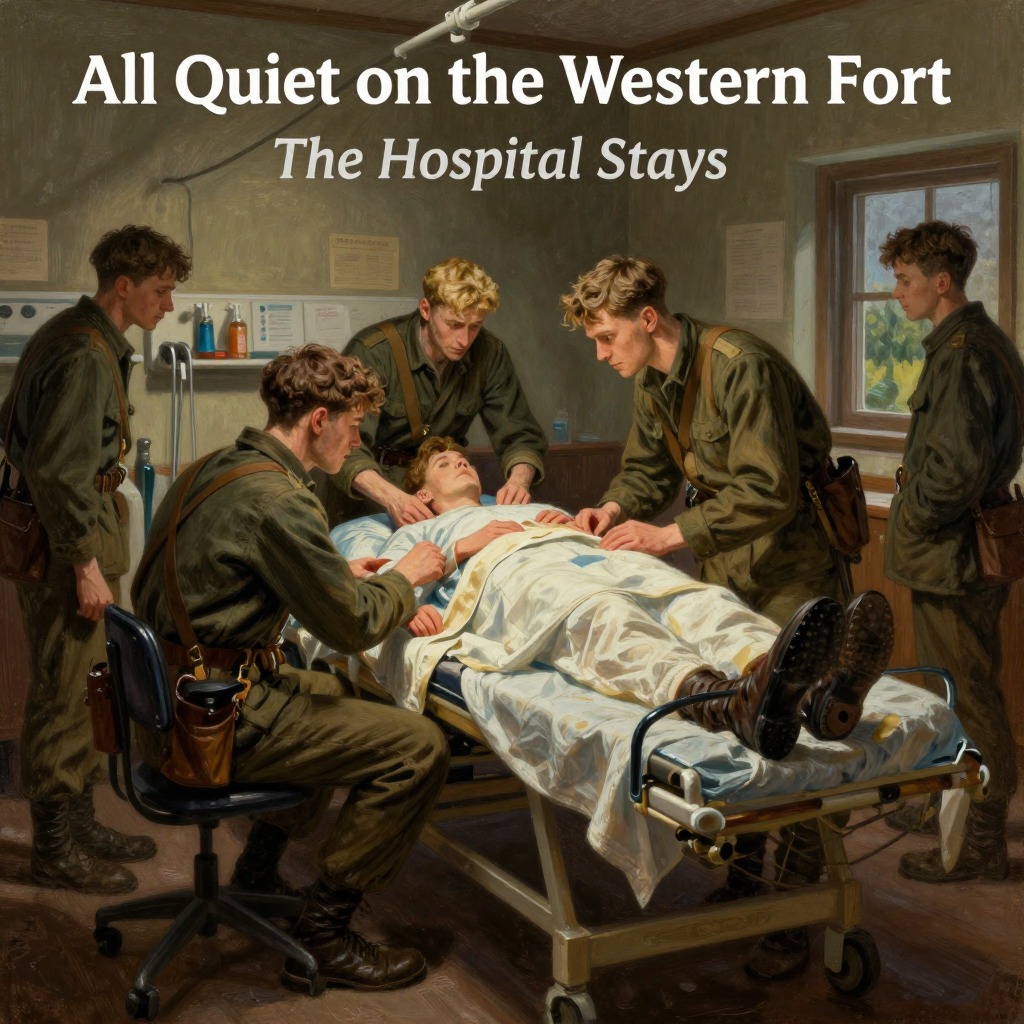
The Catholic Hospital is the medical institution where Paul Bäumer and Albert Kropp are sent after being wounded by shrapnel during an evacuation mission. It represents a crucial space in the narrative where the war's physical and psychological toll is laid bare, and where the soldiers' struggle for control over their own bodies and fates continues even behind the lines. The hospital is not merely a place of healing but a microcosm of the war's absurdities, where religious routine clashes with the needs of the wounded, where surgeons' ambitions can override patients' welfare, and where the constant presence of death forces the men to confront the fragility of life and the meaning of their sacrifice.
Arrival and First Impressions
Paul and Albert are admitted to the Catholic Hospital after being wounded by a shell while evacuating a village. They are placed in the same room, a piece of luck they engineer by bribing a medical sergeant-major with cigars. The hospital is filled with wounded from their train, and the sheer number of cases means they are not examined immediately. The flat trolleys with rubber wheels pass continually along the corridor, carrying men stretched out at full length, a sight that Paul finds damnable. The hospital is noted for its good treatment and food, a reputation that proves true, but the initial experience is one of chaos and pain. The bandages burn like fire, and the men drink glass after glass of water to quench their thirst.
Conflict with Religious Routine
The hospital's religious character immediately creates conflict. Every morning, the sisters leave the doors open to conduct Morning Devotion, a practice that prevents the wounded from sleeping. Paul, furious, throws a bottle into the corridor to stop the praying. The hospital inspector arrives to threaten punishment, but a fellow patient, Josef Hamacher, claims responsibility because he possesses a "shooting licence"—a certificate of periodic insanity from a head wound that grants him immunity from consequences. This incident establishes the hospital as a place where the soldiers must fight not only their wounds but also the institutional structures that ignore their basic needs.
The Dying Room and the Reality of Death
Josef Hamacher, a veteran of the hospital, explains the existence of the "Dying Room," a small room at the corner of the building where patients who are about to die are moved. This is done for convenience, to reduce work and prevent other patients from dying in sympathy. The room lies beside the lift to the mortuary. The knowledge of this room haunts the ward. When Peter, a young soldier with a lung wound, is taken there, he tries to roll off the trolley, crying out that he will come back. Hamacher notes that many say that, but once a man goes in, he never comes through. Peter, however, defies the odds and returns, pale and thin but triumphant, a rare exception that underscores the rule of death. The hospital is a place where men die in droves, and the staff, though often well-meaning, are overwhelmed. The sisters are overworked, and the night sister is slow to respond to calls, leading to a crisis when Franz Wachter begins to hemorrhage.
Medical Care and the Surgeon's Ambition
The hospital is also a site of medical ambition that can harm patients. The chief surgeon is obsessed with operating on flat feet, a procedure that Hamacher warns will leave patients with club feet instead. He describes the surgeon as a man who wants "little dogs to experiment with" and for whom the war is a glorious time. Despite the warning, one of the young soldiers consents, reasoning that a club foot is better than being dead. This episode reveals how the hospital, rather than being a sanctuary, can be a place where the wounded are subjected to unnecessary procedures for the sake of medical science, reflecting the war's broader dehumanization.
Comradeship and Human Connection
Despite the horrors, the hospital fosters a powerful sense of comradeship. The men in the ward form a tight-knit community, supporting one another through pain and fear. They play skat, share stories, and protect each other from the authorities. The most poignant example of this solidarity is the story of Lewandowski, a Polish soldier with a severe abdominal wound. When his wife visits, the men arrange for them to have privacy, standing guard at the door while the couple consummates their reunion. The act is treated with matter-of-fact acceptance, a recognition of the human needs that persist even in the face of death. Afterward, the woman shares sausages with the men, and they call her "Mother," creating a brief, warm family unit within the sterile hospital walls.
Paul's Recovery and Departure
Paul's own recovery is slow. His leg is placed in a plaster cast, and he is operated on, vomiting for two days afterward. He is given crutches and begins to hobble around, but he cannot bear to see Albert's gaze as he moves about the room. Albert has had his leg amputated from the thigh and speaks of shooting himself. Paul's convalescent leave is granted, and he returns home to his ailing mother, but the parting from Albert is very hard. The hospital, for all its care, has not healed the deeper wounds. Paul's final departure marks the end of this interlude, but the experiences within the Catholic Hospital have permanently altered his understanding of life, death, and the institutions that govern them.